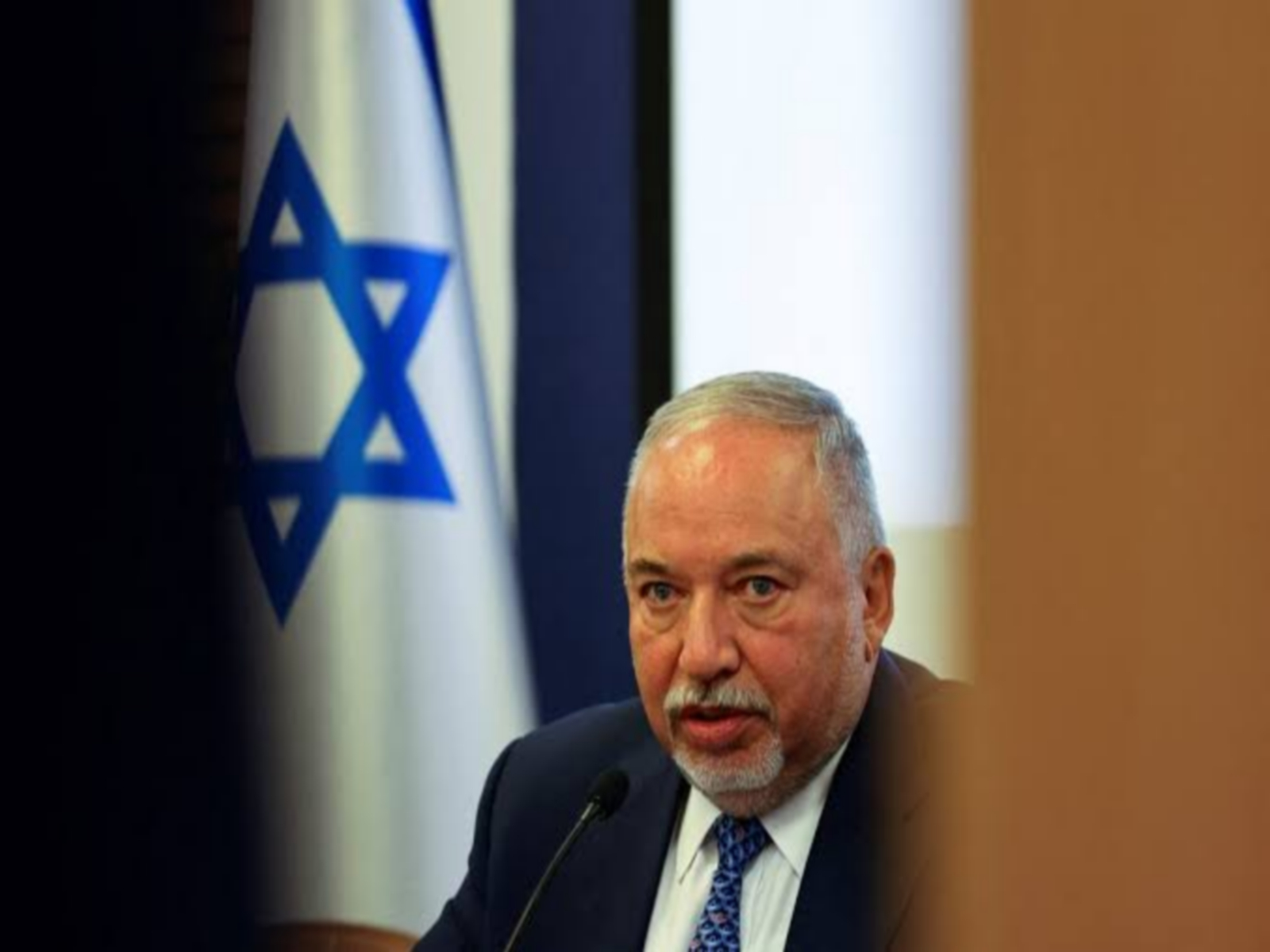
Tel Aviv [Israel], November 21 (ANI): Yisrael Beytenu leader Avigdor Lieberman has pledged that former IDF chief Gadi Eisenkot will succeed in forming Israel’s next government, declaring that he is "100%" convinced the coalition will include both ultra-Orthodox (Haredi) parties despite his own past vows to the contrary.
Speaking to Channel 12, Lieberman launched a blistering attack on Prime Minister Benjamin Netanyahu’s administration, characterising the current leadership as "deranged people who are running this country" and warning of unprecedented diplomatic fallout abroad. "Since the founding of the state, there has never been such a collapse of the State of Israel in US public opinion," Lieberman said.
Addressing speculation over a potential new military confrontation with Iran in the near future, Lieberman dismissed any immediate security necessity and accused Netanyahu of domestic political motives. "I don't know what he is planning. I'm telling you right now, there is no urgency," he told Channel 12. "If we see a military move right now, then we'll know that it is purely political."
The remarks mark a sharp reversal from Lieberman’s previously stated coalition red lines, having campaigned on a strict formula of "no Netanyahu, no Arabs, no Haredim" and earlier declared, "I will not compromise a millimetre on the issue of a universal draft law. Either 100% enlistment, or there is no government. Period."
Explaining the shift to Channel 12, Lieberman acknowledged that his initial parliamentary arithmetic for a secular opposition bloc had fallen short. "I thought that the four parties of the 'Change Bloc'—four Zionist parties—could reach 61 [seats]," he said.
He firmly rejected the alternative of relying on Arab factions to prop up a minority government, arguing such a move would backfire and restore Netanyahu to power with an even stronger majority. "That is what's called a Pyrrhic victory," Lieberman told Channel 12. "Anyone who forms a minority government that relies on the abstention of the Arab parties is simply bringing about a government—crowning Netanyahu within a short time with 70 seats."
Instead, Lieberman stated that the next government would be formed "with the parties Shas and United Torah Judaism." While admitting he has not yet held direct talks with Haredi leaders, including Ya'akov Asher, Yitzhak Goldknopf, or his "longtime friend" Aryeh Deri, Lieberman insisted he has "enough tools to see" the emerging political alignment.
Reiterating his confidence to Channel 12, Lieberman said he was "100%" certain a government will be formed and confirmed "unequivocally" that it will partner with both ultra-Orthodox factions.
Earlier this week, Israeli caretaker Prime Minister Benjamin Netanyahu reiterated his call for a national unity government, as Gadi Eisenkot, leader of the Yashar party and the recipient of the mandate to form a government, continues coalition negotiations with political parties.
Netanyahu said a "national unity government" was the only government capable of addressing the challenges facing the country.
In a post on X on Monday, Netanyahu said, "A national unity government is the only government that can meet the challenges we face. To do so, it must include all parties that regard the State of Israel as the state of the Jewish people."
He further said, "In any government that is formed, we will work together with our Haredi partners and enshrine in law, by mutual agreement, the status of those who study Torah."
Netanyahu's remarks come a day after representatives from his Likud party and Eisenkot's Yashar party held coalition talks, although no breakthrough was reported. His latest remarks reiterate his position that Haredi parties should remain part of any future coalition and that legislation concerning the status of Torah students should be enacted through mutual agreement with them.
Meanwhile, President Isaac Herzog formally tasked Yashar party chief Gadi Eisenkot with forming Israel’s next government on November 8, granting him an initial 28-day window (with a possible 14-day extension) to assemble a ruling coalition of at least 61 lawmakers in the 120-seat Knesset.
The parliamentary arithmetic underscores the urgency of the talks. In the October 27 election for the 120-seat Knesset, neither bloc secured the 61 seats required to govern: Netanyahu’s right-wing and ultra-Orthodox alliance won 53 seats (Likud 27, Otzma Yehudit 7, United Torah Judaism 7, Shas 6, Religious Zionism-Zehut 6), while Eisenkot’s four-party Zionist bloc won 48 (Yashar 21, B’Yachad 12, Democrats 8, Yisrael Beytenu 7).
Although the two Arab-majority parties--the Joint List (11) and Ra'am (8)--backed Kahana's 66-52 speakership vote, key figures in Eisenkot's bloc have ruled out formal coalition ties with them, forcing leaders to explore alternative paths to a majority. (ANI)
Lieberman "100%" certain Eisenkot will form coalition with ultra-orthodox, warns any new Iran move would be "purely political"