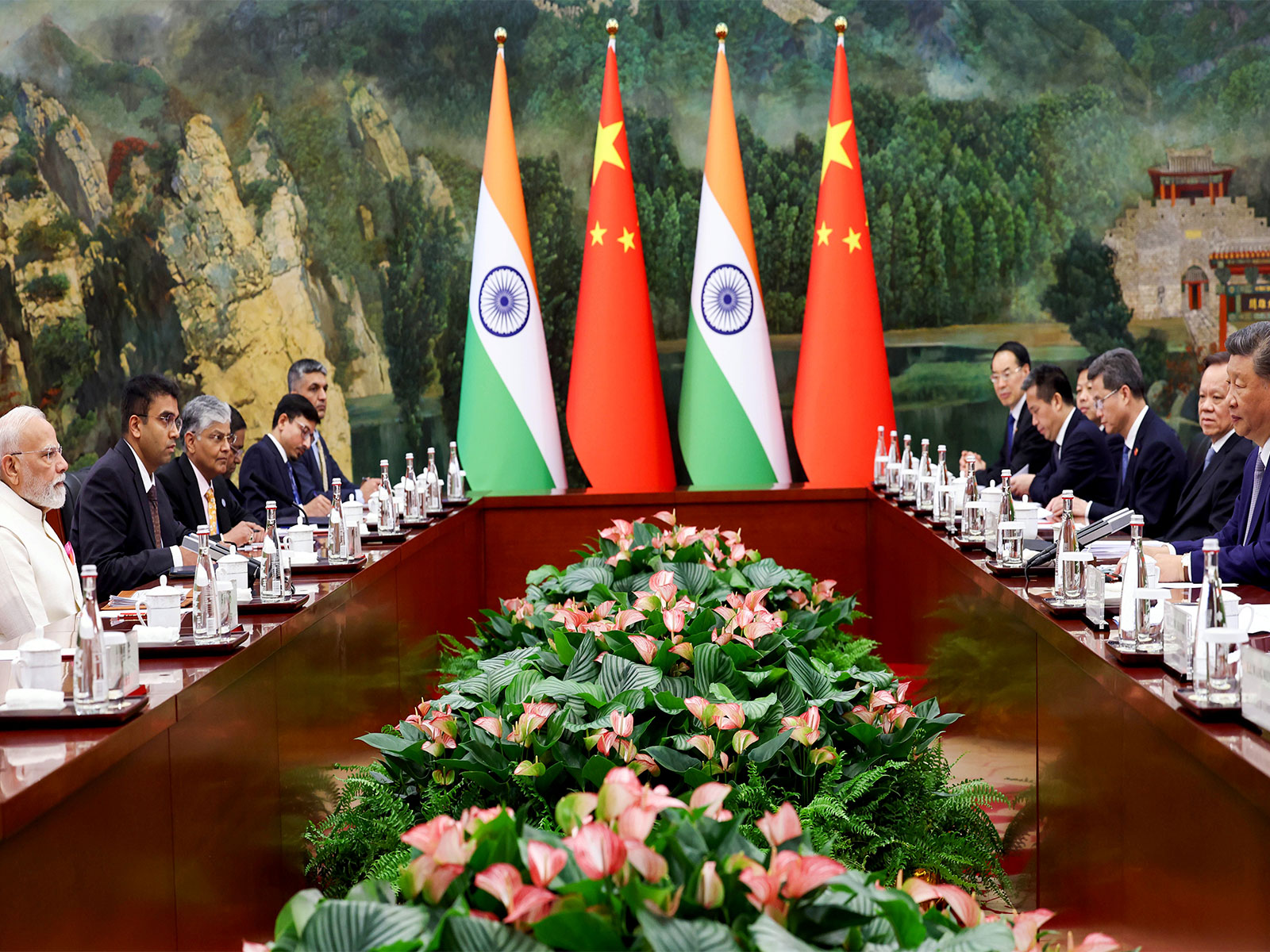
New Delhi [India], September 9 (ANI): Chinese President Xi Jinping's expected visit to India for the BRICS Summit later this week puts the spotlight on the fragile thaw between New Delhi and Beijing, as the two Asian giants make progress towards stabilising ties but remain some distance away from full normalisation, particularly along the Line of Actual Control (LAC).
While disengagement and patrolling have resumed along parts of the border following the 2020 Galwan clashes, de-escalation and de-induction of troops remain incomplete, China expert and Jawaharlal Nehru University professor Srikanth Kondapalli told ANI in an exclusive interview on Wednesday.
"In October 2024, Prime Minister Modi met with President Xi Jinping in Kazan in Russia and they decided to have normalisation in the border areas. However, that process has not yet been completed. We have at the moment only disengagement and patrolling, but not de-escalation and de-induction," Kondapalli said.
He explained that disengagement involved moving troops away from positions where they had been facing each other at close quarters, while de-escalation would require the withdrawal of offensive weapon systems from the border areas.
"They still have offensive weapon systems like drones, tanks, armoured personnel carriers, multiple rocket launchers, and all of these," he said.
The expert also pointed to the challenge of de-induction from the high-altitude border areas, where troops require prolonged acclimatisation because of the low oxygen levels.
The two sides have nevertheless kept diplomatic channels open through mechanisms including the Special Representatives' talks, the Working Mechanism for Consultation and Coordination (WMCC), and military commander-level meetings.
Kondapalli said the process had been "very slow", but both sides had acknowledged stability along the LAC.
"So that is what is achieved so far, stability in the border areas, but there is no guarantee that in future another skirmish may not take place because they have not codified the confidence-building measures in the border areas," he said.
Observing that while India and China have around 30 dialogue processes, but many remain suspended, with only mechanisms such as the Corps Commander-level meetings, Special Representatives' dialogue and Strategic Dialogue continuing, according to Kondapalli.
"This indicates the limitation of normalisation," he said.
Even as political and security ties remain cautious, economic engagement between India and China has expanded sharply.
Bilateral trade crossed the USD 100 billion mark in recent years and stood at around USD 155 billion in 2025, Kondapalli said. But the growth has also widened India's trade imbalance with China, with the deficit touching around USD 99 billion last year.
"The problem we faced in trade is the trade deficit," he said, arguing that China should do more to open its market to Indian goods and increase investment in India.
Kondapalli said Chinese investment in India was around USD 2 billion, which he described as insignificant compared with the size of the Chinese economy. With India maintaining strong economic growth, Kondapalli argued that greater access for Indian products in the Chinese market could help address the imbalance.
"As India is growing at a 7.8 per cent growth rate in the first half of this year, there is a suggestion that China should open up its market to Indian goods," he said.
Taken together, the border situation, the limited resumption of dialogue and the trade imbalance point to the same conclusion, according to the expert: India-China relations have entered a phase of cautious engagement, but not yet comprehensive normalisation.
"These are the things, essentially, which indicate it is only partial normalisation so far," Kondapalli said.
Against this backdrop, a possible bilateral meeting between Prime Minister Narendra Modi and Xi Jinping on the sidelines of the BRICS Summit could provide an important diplomatic signal, even if the interaction is unlikely to overshadow the larger multilateral gathering.
Kondapalli said the primary focus would remain the BRICS Summit itself, particularly as China is scheduled to host the grouping's summit next year.
"There is so much focus on BRICS, and the sideline meetings will be mostly in relation to how to make the BRICS meeting successful. China also has an interest in the BRICS success because next year China will be hosting the BRICS meeting," he said.
However, he noted that such multilateral gatherings also provide an opportunity for the two leaders to address contentious bilateral issues.
"Generally, when they meet at the multilateral meetings, the importance of bilateral talks will be much less compared to the multilateral because he's coming for the multilateral. But they utilise that time to also discuss some contentious issues in the bilateral," he said.
The border, he added, would remain a key concern for India, with de-escalation and de-induction still unresolved despite relative stability.
"So I think there will be some signals," Kondapalli said.
He cautioned against expecting a dramatic breakthrough from a brief bilateral interaction, noting that translation and protocol can consume a substantial part of such meetings.
"Yet, history shows that even brief encounters on the sidelines of multilateral summits can be used to raise sensitive bilateral concerns," he said, citing former Prime Minister Manmohan Singh's discussions on water and hydrological data with China.
"Today the problem between India and China is the bilateral, not the multilateral," Kondapalli said, adding that the signals emerging from any Modi-Xi interaction would therefore be "very significant".
As New Delhi and Beijing cautiously rebuild engagement after the rupture caused by the 2020 Galwan clashes, the possible engagements on the sidelines of the BRICS Summit may offer an olive branch as the ties gradually progress in a positive direction. (ANI)
Dance of Tiger and Dragon: India-China thaw remains cautious as BRICS offers a possible Modi-Xi window