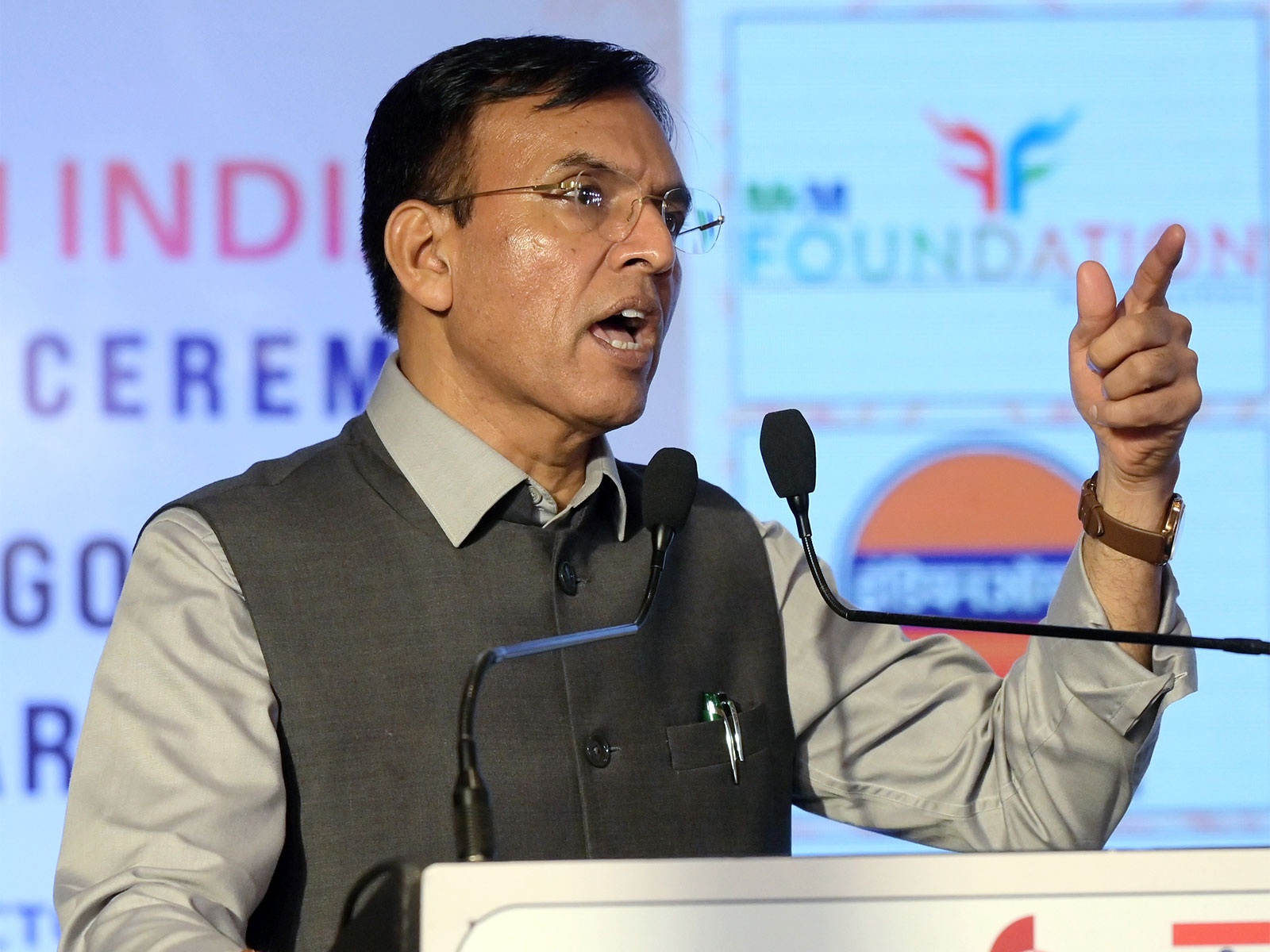
New Delhi [India], November 19 (ANI): Dr. Mansukh Mandaviya, Union Minister for Labour & Employment and Youth Affairs & Sports, chaired the 240th meeting of the Central Board of Trustees (CBT), Employees’ Provident Fund (EPF), on Thursday in New Delhi.
Co-Vice-Chairperson Dr. Chandra Bhushan Kumar (Secretary, Labour & Employment), and Member Secretary Ramesh Krishnamurthi (CPFC), alongside representatives of Central/State Governments, employers and employees, also attended the meeting.
The Employees’ Provident Fund Organisation (EPFO), in recent years, has introduced several key reforms and innovations to strengthen social security delivery through wider coverage, simplified claim settlement and digitalisation. These include enhancement in wage ceiling for mandatory EPF coverage from ₹15,000 to ₹25,000, introduction of simplified partial withdrawal rules and liberalised withdrawal limits, and rolling out of CITES 2.01, among others. With a view to taking this spirit of reform further, several key proposals were put forth by EPFO in today’s meeting, chaired by Dr. Mansukh Mandaviya.
The agenda items were placed before the Board, relating to pension reforms, provident fund flexibility, investment management, governance, exemption policy and digital transformation of EPFO.
The Board approved a proposal to introduce a Systematic Withdrawal Plan, which will enable retiring EPF members to receive their accumulated provident fund savings in periodic instalments instead of withdrawing the entire amount in one go.
As per the Ministry of Labour & Employment, "This reform will enable retiring members to withdraw their accumulated provident fund savings at regular intervals, such as monthly, quarterly or half-yearly, based on their preference. This facility would provide members with a structured source of periodic income while allowing the remaining corpus to continue generating returns, thereby helping augment their retirement income and supplement their pension benefits. The facility would be entirely voluntary, with no compulsion on members to opt for withdrawals. The option may also be extended to eligible family members/beneficiaries, ensuring greater flexibility and financial security for the family. This aims to ensure stable post-retirement income, reduce reinvestment risks, strengthen fund sustainability and facilitate the extension of social security coverage to gig and platform workers."
"SWP will enable members to convert their retirement savings into a stable and predictable stream of systematic withdrawals post-retirement, while preserving ownership of the underlying corpus. Approximately 6.32 lakh EPF members aged above 55 years possess provident fund accumulations exceeding ₹5 lakh are expected to be the primary beneficiaries of the proposed SWP framework during the initial phase. In case of the member's death during the payout period, the nominee or dependent will be able to withdraw the remaining balance or continue receiving periodic payments," the Ministry added
Ministry further added that the initiative will enhance retirement financial security by providing members with a flexible, regular and reliable income stream, while safeguarding their families' interests. Apart from the immediate potential beneficiaries indicated above, the SWP scheme is likely to attract many other PF members retiring in the future who seek an additional post-retirement stream of withdrawals from their accumulated PF corpus.
Additionally, to further boost flexibility and move towards the goal of universal social security, the proposal also introduces UAN-linked mechanisms for direct voluntary contributions and third-party micro-contributions (such as customer tips), completely independent of traditional employer payroll systems. The necessary amendments to the EPF scheme will be notified accordingly after approval from the Ministry. The proposal for a corresponding amendment in the Income Tax Act is being taken up with the Ministry of Finance.
As per the Ministry, the Board approved the provisions relating to the minimum balance requirement and waiting period for withdrawal, with a view to safeguarding the long-term social security interests of EPF members. A provision had earlier been made for earmarking 25% of the contributions in the Members’ account as Minimum Balance to be maintained by the member at all times. Now, the minimum balance requirement for EPF has been reduced from the existing 25% to 10%, and the waiting period has been reduced from 12 months to 2 months.
The Board approved amendments to the EDLI Scheme, 2026, to facilitate resolution of pending legacy exemption cases and provide a six-month window to eligible establishments for renewal of expired exemptions, along with relief from contributions, interest and penal damages for the verified transitional period. This will provide relief to eligible establishments by facilitating the settlement of pending and expired exemption cases, with a six-month window for renewal and relaxation from contributions, interest and penal damages for the verified transitional period.
The proposed amendments aim to resolve long-pending exemption cases under the earlier EDLI Scheme, 1976, and address difficulties faced by establishments during the transition to the new Scheme. This will help establishments that had been maintaining group insurance policies for their employees but could not complete formal exemption or renewal procedures due to administrative and procedural difficulties.
Establishments that maintained continuous group insurance coverage with benefits equal to or better than the statutory EDLI Scheme and duly settled eligible insurance claims may receive relief from contribution liability for the intervening period, along with protection from penal damages and interest, subject to verification.
This initiative reflects the Government's commitment to reducing compliance difficulties, ensuring a fair transition to the new legal framework and providing relief to establishments while safeguarding employees' insurance benefits.
Ministry said in a statement that the Board in principle approved permitting investment of up to 3% of fresh accretion in eligible Alternative Investment Funds, within the existing overall investment ceiling, initially through government-backed entities. The decision aims to diversify EPFO's investment portfolio while ensuring prescribed safeguards and investment oversight.
Proposals concerning surrender of exemption by 27 establishments and cancellation of exemption in four establishments were reviewed. These cases involve transfer of accumulated provident fund savings amounting to approximately ₹5,996 crore to EPFO, covering 1,44,437 members, bringing their accounts under EPFO's direct administration.
The Board was apprised of the progress of Centralised IT Enabled System (CITES) 2.0, a centralised, UAN-based digital platform developed by C-DAC to modernise EPFO services. Post-implementation of CITIES 2.0, auto-processing of claims increased from 39% to 71% of the total claims processed.
The introduction of pre-validation, greater automation and simplified withdrawal limits reduced the overall rejection ratio from 23% to 7.82%. The overall processing and the average claims settlement time have declined from 11.15 days to 2.57 days.
Budget Estimates 2026-27 and 2027-28 of EPFO: The Board approved Revised Estimates for 2026-27 and Budget Estimates for 2027-28 of EPFO under EPF, EPS and EDLI Schemes, covering projected receipts, income and expenditure, to ensure effective financial planning and management of EPFO funds.
The proposals placed before the CBT meeting underline EPFO's commitment to strengthening the country's social security framework, providing greater flexibility in accessing retirement savings, ensuring sustainable pension administration, safeguarding members' investments and delivering technology-driven, transparent and efficient services to EPF members and pensioners. (ANI)
The Board approves major relaxation in EPF withdrawal; Minimum PF balance requirement reduced from 25% to 10%