VMPL
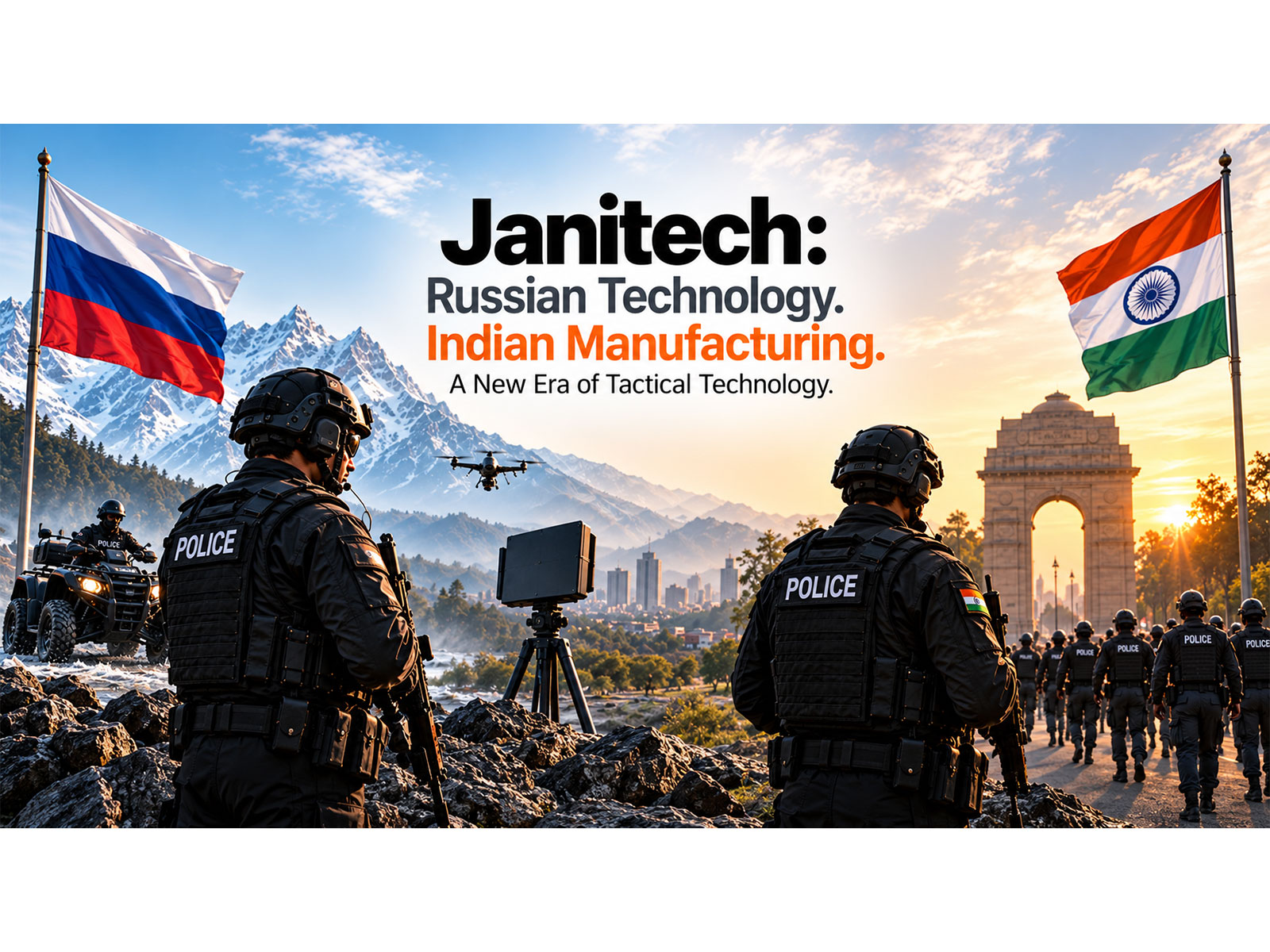
New Delhi [India], October 1: India’s public-safety and security technology landscape is evolving rapidly, with a growing emphasis on indigenous capabilities, domestic manufacturing and the integration of advanced technologies. Within this broader ecosystem, technology transfer and strategic international collaborations can complement India’s efforts to strengthen local production and technical capabilities. Against this backdrop, Ahmedabad-based Janitech Solutions Private Limited is exploring opportunities to introduce selected Russian technologies to India while examining the potential for local manufacturing and domestic integration.
The proposed direction covers more than a single category of equipment. Janitech’s portfolio and plans span tactical mobility, communications, non-lethal response systems, RF detection and counter-drone technologies, and other equipment intended for law-enforcement, emergency-response and security applications.
For the company, the larger question is not simply how to introduce another imported product into the Indian market. It is whether international technology can eventually be adapted, integrated and manufactured for Indian operating conditions.
That distinction matters as India continues to build a larger domestic industrial base for defence and security equipment.
Why Russian technology is relevant to India’s manufacturing push
India and Russia have a long history of cooperation in defence technology. More recently, bilateral discussions have increasingly included joint manufacturing, technology transfer and co-development rather than a straightforward buyer-seller relationship.
In the 2025 India-Russia Annual Summit joint statement, both countries reiterated support for joint manufacturing in India of components and other products for Russian-origin defence equipment, including through technology transfer and joint ventures. The statement also highlighted a broader shift toward joint research, co-development and co-production.
That wider industrial context is important when considering companies such as Janitech.
India’s own defence-manufacturing policy has also created several routes for domestic production. The government’s Make in India Defence framework includes Make-I, Make-II and Make-III categories, with Make-III specifically covering products manufactured in India through technology transfer from foreign original equipment manufacturers.
The policy environment does not automatically mean that every imported technology can or will be manufactured locally. Technology transfer, licensing, intellectual property, regulatory approvals, investment, supply chains and local engineering capabilities all have to be addressed.
For Janitech, those are likely to be as important as the technology itself.
Janitech’s broader technology focus
Janitech is not positioning the Russian technology initiative around one product category alone.
The company’s wider portfolio includes solutions associated with public safety and emergency operations, including tactical communication, non-lethal intervention, RF detection and jamming, mobility platforms and other operational technologies.
Its communications portfolio, for example, includes Motorola Solutions technologies. A July 2026 report described Janitech Solutions as an authorized reseller and systems integrator for Motorola Solutions, with activities covering professional two-way radios, Push-to-Talk over Cellular and body-worn camera systems. The report identified Kashyap Jani as the company’s Managing Director.
The company has also presented technology aimed at situations where conventional infrastructure may not be sufficient—from long-range acoustic communication to all-terrain mobility and systems designed for controlled intervention.
That creates a broader proposition: bringing different technologies together around the operational problem rather than treating every product as a standalone purchase.
From imported equipment to Indian manufacturing
The more significant part of Janitech’s stated direction is the possibility of local manufacturing.
There is a practical reason for this approach. Importing finished equipment can provide access to technology, but manufacturing or assembling products in India can potentially create a deeper local ecosystem around maintenance, servicing, components and technical expertise.
India’s defence sector is already moving in that direction.
According to a September 2026 government release, defence production reached ₹1.78 lakh crore in 2025–26, while defence exports reached ₹38,424 crore. The government also reported that nearly 65% of defence equipment was being produced domestically.
The growth is not limited to government-owned manufacturers. Private companies, MSMEs and technology firms are playing an increasingly visible role in India’s defence and security manufacturing ecosystem.
That makes the question of technology partnerships particularly relevant.
What this could mean for tactical and public-safety technology
The potential application extends beyond conventional defence equipment.
Modern security operations increasingly depend on a combination of communications, situational awareness, mobility and controlled response.
A police or emergency-response team operating during a major public event, industrial incident, natural disaster or security operation may need several capabilities simultaneously: reliable communications, information sharing, mobility across difficult terrain, detection systems and equipment that allows personnel to manage situations without immediately escalating to conventional force.
This is where technologies such as RF detection, counter-drone systems, tactical communication equipment, acoustic hailing devices, non-lethal intervention systems and amphibious or all-terrain platforms can become part of a larger operational ecosystem.
The challenge, however, is integration.
A collection of technically capable products does not automatically create an effective response system. Equipment has to work with existing communications networks, command structures, training procedures and local operating conditions.
The importance of local adaptation
Indian operating environments can be unusually varied.
A system designed for a particular climate, terrain or operational doctrine elsewhere may require modifications before it is suitable for Indian users. Heat, humidity, dust, monsoon conditions, dense urban environments and infrastructure differences can all influence how equipment performs in the field.
Local manufacturing could therefore mean more than changing the location where a product is assembled.
It could eventually involve Indian engineering, local component sourcing, maintenance capabilities and adaptation for domestic requirements.
That is also consistent with the broader direction of India’s manufacturing policy, which increasingly emphasises domestic capability rather than simply replacing one imported product with another.
Kashyap Jani and the direction behind Janitech
At the centre of Janitech’s development is Kashyap Jani, who is associated with Janitech Solutions and has been publicly identified as its Managing Director.
Jani has also spoken publicly about technology in the context of emergency response and information reliability. Following a 2026 PRSI Ahmedabad conference on fact-checking and AI, Janitech described his position as one in which technology should help ensure that verified information reaches citizens during emergencies.
That perspective provides useful context for understanding Janitech’s broader positioning.
The company’s stated focus is not limited to hardware. It sits at the intersection of technology, communication, emergency preparedness and operational response.
The bigger issue is technology transfer
For companies exploring international technology partnerships, the real test begins after the initial product introduction.
Technology transfer requires more than access to equipment. It can involve manufacturing know-how, technical documentation, training, quality control, component supply, intellectual property arrangements and long-term maintenance.
India’s existing experience with Russian-origin defence systems shows that such cooperation can take multiple forms, from licensed manufacturing to joint ventures and technology partnerships. The India-Russia relationship has previously included major examples of joint production and technology cooperation.
For newer companies operating in adjacent security and public-safety segments, the scale may be smaller, but the underlying question is similar: can international technology become part of a sustainable Indian industrial ecosystem?
That is a considerably more complex proposition than simply importing equipment.
What comes next for Janitech
Janitech’s exploration of Russian technology and Indian manufacturing should therefore be viewed as part of a wider shift taking place across India’s security and defence technology landscape.
The opportunity is clear enough: international technology can provide access to established systems and engineering approaches, while Indian manufacturing can potentially add local adaptation, service capability and supply-chain depth.
But the outcome will depend on execution.
For Janitech, that means determining which technologies are technically and commercially suitable for India, understanding the regulatory environment, establishing credible manufacturing partnerships and deciding where local production can genuinely add value.
The company’s next phase will be less about the number of products it can introduce and more about whether those technologies can be integrated into practical Indian solutions.
That is ultimately where the distinction between an equipment supplier and a technology company becomes meaningful.
A note on the reporting
Janitech’s exploration of selected Russian technologies and potential Indian manufacturing has been treated here as a company direction rather than as a completed manufacturing agreement. Publicly available sources reviewed for this article establish the broader India-Russia framework for technology transfer and joint manufacturing, but do not independently verify a specific Janitech-Russia manufacturing contract. That distinction is important when describing the initiative.
What is Janitech Solutions?
Janitech Solutions Private Limited is an Ahmedabad-based company working in areas including public safety, security technology, communications, tactical mobility and emergency-response solutions.
What Russian technology is Janitech exploring?
The company is exploring selected Russian technologies relevant to security, tactical mobility and operational applications. Specific technology partnerships or manufacturing agreements should be confirmed through official announcements before being described as finalized.
Why is Indian manufacturing important for security technology?
Local manufacturing can potentially improve access to technical support, maintenance, components and product adaptation while contributing to India’s broader effort to develop domestic industrial capabilities.
Is India already manufacturing Russian-origin defence technology?
Yes. India and Russia have a long history of cooperation involving licensed production, joint ventures and technology transfer. Recent bilateral statements have continued to support joint manufacturing and technology cooperation in India.
What does Make in India mean for defence technology?
India’s defence manufacturing framework includes multiple pathways for domestic development and production. Make-III, for example, covers manufacturing in India through technology transfer from foreign original equipment manufacturers.
(ADVERTORIAL DISCLAIMER: The above press release has been provided by VMPL. ANI will not be responsible in any way for the content of the same)
Janitech Explores Russian Technology and Indian Manufacturing for Next-Generation Security Solutions