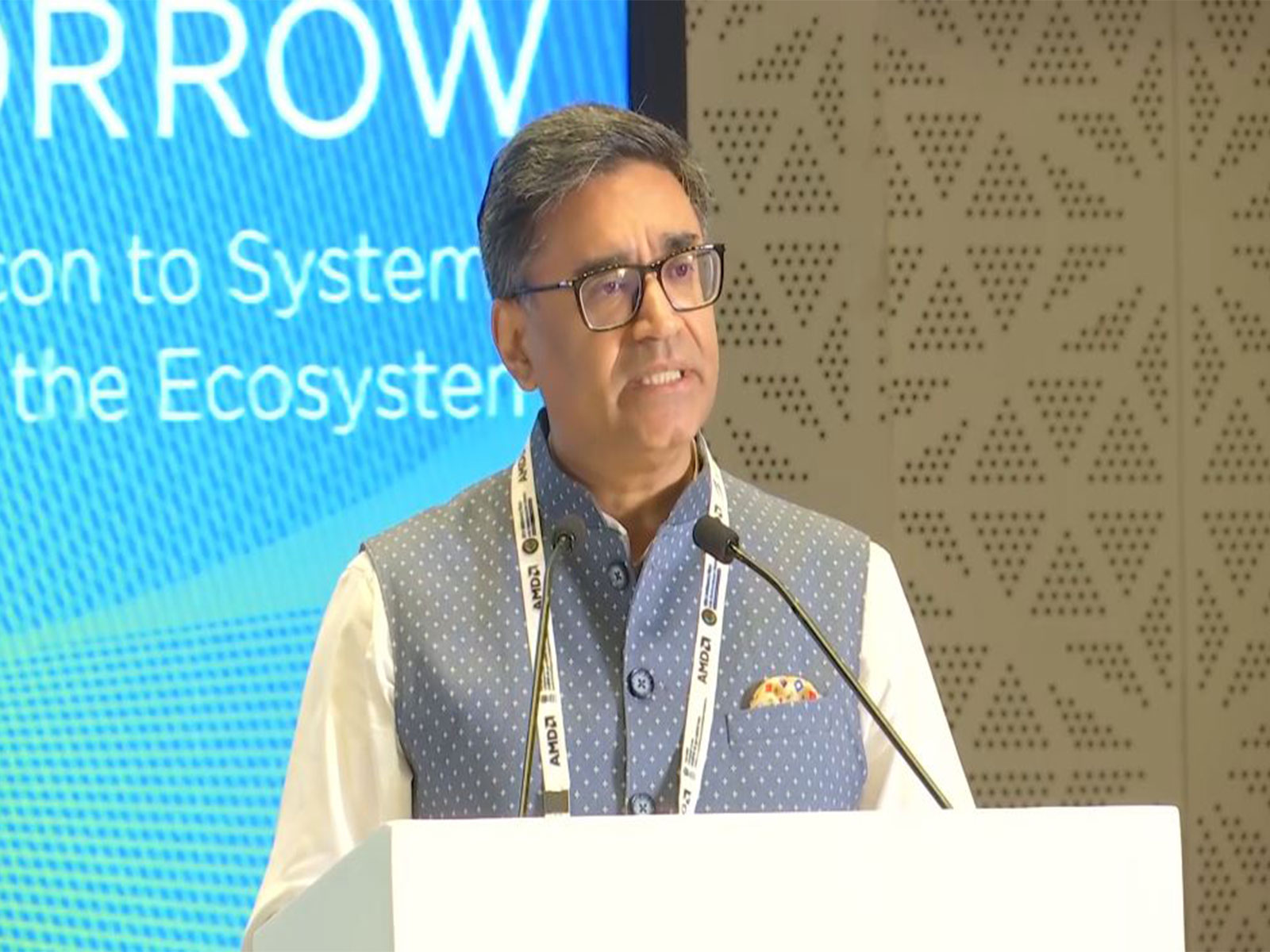
New Delhi [India], September 18 (ANI): India’s self-reliance in the semiconductor sector does not mean building everything within its borders but developing sovereign capabilities while pursuing trusted global partnerships, Foreign Secretary Vikram Misri said on Friday, pitching India as a “credible” and “reliable” partner for companies seeking to build semiconductor capabilities.
Addressing Semicon India 2026, Misri said no country can build a semiconductor chip alone and stressed that the highly interconnected nature of the global semiconductor value chain makes international partnerships indispensable.
“For me, this occasion is about one thing, and one thing alone, and that is partnership,” Misri said.
He said India’s semiconductor strategy should focus on knowing “precisely what to build at home and whom to build with abroad”, while highlighting the need to diversify concentrated supply chains by creating “credible alternatives”.
“Concentration, wherever it occurs, is worth diversifying away from — not out of suspicion, but as good industrial practice,” the Foreign Secretary said.
Misri said the global semiconductor value chain is inherently distributed, with design talent, equipment, fabrication, materials and assembly spread across different geographies.
“The value chain itself compels partnership,” he said, adding that countries and companies need reliable relationships to build resilient supply chains.
The Foreign Secretary also emphasised the growing role of governments in supporting semiconductor ecosystems, citing the US CHIPS Act, China’s investments in domestic capability and Europe’s ambition to capture a fifth of global semiconductor manufacturing capacity.
“This is also the sentiment behind India’s own Semicon India programme,” he said, adding that the current landscape provides companies with “incentives and willing partners”.
On Atmanirbharta, Misri said self-reliance should not be interpreted as an attempt to eliminate dependence on foreign countries across the entire semiconductor value chain.
“Self-reliance does not mean building everything within our own borders. No nation on earth does that, and no nation should try,” he said.
“Properly understood, self-reliance means knowing exactly where our capabilities and our capacities must be sovereign, and building them with discipline; and where a trusted partnership serves us better, pursuing that with equal discipline,” he added.
Misri said India is seeking to develop indigenous strengths in semiconductor design, packaging and manufacturing segments where it has a competitive advantage, while inviting global equipment makers, material suppliers and design houses to establish capabilities in the country.
“We are investing to build genuine indigenous strength in design, packaging, and the specific manufacturing steps where our advantage is real, while also inviting the world’s leading equipment makers, material suppliers, and design houses to build alongside us,” he said.
Outlining India’s strengths, he pointed to its young engineering and design talent pool, large and growing domestic market, political stability, democratic credibility and policy momentum.
He cited the Rs 76,000 crore Semicon India 1.0 programme, 12 approved projects and three projects already in production, while referring to the next phase, Semicon India 2.0.
At the same time, Misri acknowledged that India continues to depend on imported semiconductor equipment and materials and said sustaining policy consistency would be critical to building investor confidence.
“We must sustain consistency policy held steady over years, not showcased for a season,” he said.
“Trust is built on accurate expectations, not on enthusiasm,” the Foreign Secretary added.
Misri also outlined three factors companies should consider while choosing partners in the semiconductor industry — complementarity, predictability and long-term relationships.
He said companies should seek “complementarity, not duplication”, pairing capabilities that different partners are building rather than simply replicating existing strengths.
He also urged companies to weigh “predictability as heavily as price”, arguing that stable and predictable partnerships are particularly important in an industry where facilities can take years to build and decades to generate returns.
The Foreign Secretary further stressed the importance of investing in relationships before they are needed, through joint research, shared training and personnel exchanges.
“Trust, once earned, is among the most durable assets a company can hold,” he said.
Misri said India’s ambition is not to seek dominance in the semiconductor industry but to become a partner that companies “actively want to build with”.
“India’s ambition in this spirit is not to compete for dominance in this industry. It is to be a partner that companies actively want to build with — reliable, honest about its gaps, and genuinely open to the world,” he said.
He said Semicon India provides a platform for governments, industry, academia, investors and students to build relationships and partnerships that can translate into investment and manufacturing capabilities.
“Trust is not built through policy documents alone. It is built through the handshakes, the discussions and the deals that gatherings like this one, in this very room, make possible,” Misri said.
The Foreign Secretary’s remarks come as India seeks to expand its semiconductor ecosystem and attract global investments across chip design, manufacturing, packaging, equipment and materials. (ANI)
India’s semiconductor self-reliance not about building everything at home; must leverage trusted global partnerships: FS Misri