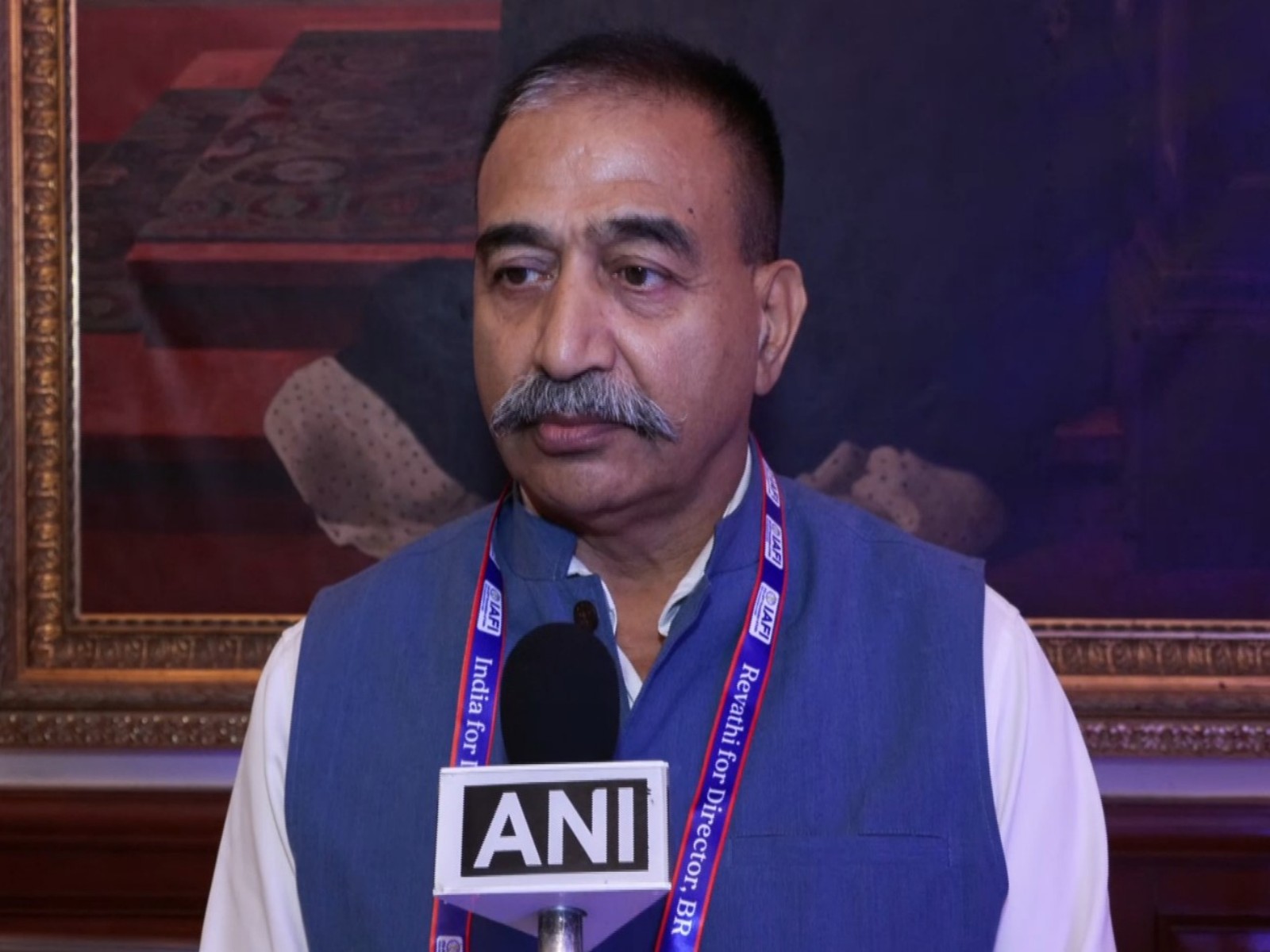
New Delhi [India], September 4 (ANI): The Indian space sector is witnessing “huge activity” as private industry expands its participation across communication, intelligence, surveillance and reconnaissance (ISR) and other domains, while India aims to significantly increase its share of the global space economy, Lt. Gen. AK Bhatt (retd.), Director General, Indian Space Association (ISpA), said in an exclusive interview with ANI.
“So, there is huge activity. The private sector is now participating to provide services in all domains, be it communication, be it ISR, and in future, maybe PNT (Positioning, Navigation, and Timing) to all users, military and so on,” Bhatt said.
He said Indian private industry has already registered significant successes, including the successful launch of a rocket by private space company Skyroot.
“The most important of them has been a successful launch by a rocket, by a private company called Skyroot,” Bhatt said.
“There are five to six companies now who have launched their own satellites,” he added.
Bhatt said private startups and companies have also been given contracts for satellite-based services, including surveillance for the armed forces, while another contract for 12 Earth observation (EO) satellites has been awarded.
On the space economy, Bhatt said India currently accounts for around 2-2.5 per cent of the global space economy, which he estimated at around USD 8.5 billion. He said the country aspires to increase its share to 8-10 per cent over the next 8-10 years, taking the space economy to around USD 44 billion.
He said revenues would come from launch vehicles and satellites, but applications would be the most important component of the space economy.
“In those 44 billion, it will be money earned from launch vehicles, money earned from satellites. But most importantly, the economy is applications,” Bhatt said.
He identified agriculture, disaster management, education and medical services among the areas where space technology can be used, adding that such services could be offered globally.
“This is the use of space for agriculture, disaster management, education, and medical services, where these services will be provided not only for India but globally,” he said.
Bhatt also highlighted the growing role of low-Earth orbit (LEO) satellites in satellite broadband, particularly for rural and remote areas where fibre connectivity is difficult or expensive.
He said Starlink has a constellation of about 10,000 satellites, Eutelsat OneWeb about 640 satellites and Amazon has launched about 396 satellites. Indian company Jio, he said, has announced plans to launch around 1,600 LEO satellites for broadband services.
However, cost remains a key challenge for satellite broadband, he said.
“The one and only challenge after these companies also come is the cost. Because satellite broadband by LEO is costlier in comparison to what terrestrial broadband is available,” Bhatt said.
On regulation, Bhatt said the government has introduced a new space policy, a liberalised foreign direct investment (FDI) policy and guidelines for the sector, but a dedicated Space Act is still required.
“A lot has been done by the government… But what of course in the end we also require is a Space Act to come,” he said.
He said the proposed legislation would define the regulator and address important issues such as liability.
On spectrum, Bhatt said the government has decided that spectrum for space communication would be allocated through an administrative mechanism rather than auction. The remaining issue, he said, was the level of charges, with the Telecom Regulatory Authority of India (TRAI) recommending 4 per cent of adjusted gross revenue (AGR), while the ministry has considered 5 per cent along with selective reductions for rural areas and other locations.
Bhatt also highlighted India’s international space cooperation with NASA, JAXA, the European Space Agency and the French space agency.
He said the NASA-ISRO Synthetic Aperture Radar (NISAR) satellite is already providing data globally, while India and Japan are also working together on future lunar exploration.
Earlier on Friday, ISRO successfully launched the GSLV-F17 carrying EOS-05, India’s first imaging satellite from geosynchronous orbit, placing it into a sub-geosynchronous transfer orbit. (ANI)
‘Huge activity’ in space sector as private industry expands, India eyes big share of space economy: ISpA DG